
Blog by Eunice Odhiambo; Reparations Officer, Africans Rising
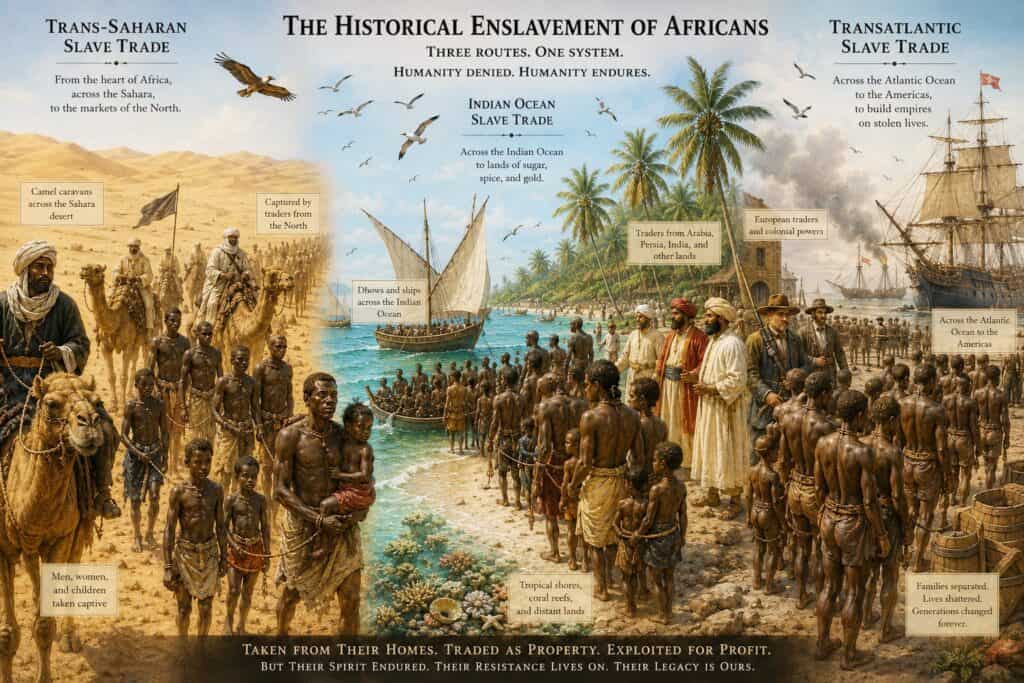
The global reparations movement has recorded significant progress in stationing the Transatlantic slave trade as a crime against humanity, with ongoing repercussions for Africans and people of African descent. Nevertheless, a major challenge lies in making the process inclusive while the other major forms of slave trade; the Trans-Saharan (7th-19th centuries), Indian Ocean (9th-19th centuries), and the Portuguese domination over those trade routes (15th-19th centuries) remain relatively neglected.
While about 12 to 12.5 million people of African descent were trafficked from Africa across the Atlantic, many more were transported in other types of slavery that are much less known. The Trans-Saharan slave trade, for example, has accounted for the transportation of between 6 to 10 million individuals over more than a millennium; during their journey through the Sahara Desert, with very high mortality rates because of dehydration, hunger, and abuse. Likewise, the Indian Ocean slave trade resulted in the transport of between 6 to 10 million individuals to Middle Eastern, Asian, and South-Eastern Asian countries. Though they varied in structure and effects ranging from domestic service, military labor to assimilation, these slave trades were equally important in their reach and effects. Portuguese imperialism since the 15th Century would further integrate these trading networks into a global system, eventually culminating in the Transatlantic Slave Trade system. All these slave trade systems can thus be considered a part of one long history of Africa’s exploitation.
The cost of invisibility and silence
Invisibility and silence have huge ramifications for the study of this history, as it implies the existence of hierarchies of suffering whereby some stories matter more than others. Besides denying communities involved in these trades including the Frere Town Descendants’ community in Mombasa Kenya, the Siddis in India/Pakistan, or the descendants of the Zanj in the Gulf region; visibility, silence erodes potential solidarity among Africans and diasporas. It is a narrative dominated by Western academics and politicians, rather than an inclusive and all-encompassing one that includes the voices of victims in other systems. “Inclusivity starts with the history of our people” argues Ambassador William Carew, Chair of the Economic Commission of the African Union ECOSOCC.
Action should follow acknowledgement
Mere acknowledgment is not enough. There has to be actual implementation of inclusivity through participation and structural reforms. A fundamental part of the process would include participation. It will be necessary for communities who suffered from the effects of all slave trades to participate directly in developing the policy agenda. In other words, the top-down approach wherein the policies are mainly dictated by state and institutional interests has to be abandoned. Regional dialogues, community forums, and transnational discussions are crucial tools to ensure the voices of historically disenfranchised people are heard. It should be noted, however, that participation should be meaningful. Communities should actively engage in decision-making.
Connected to participation is the importance of emphasising lived experience in the framework of reparations. It means that the policies will have to take into account the history, culture, and social reality of affected populations. There are distinctions between the consequences of slavery because of the difference between the plantation economy of the Atlantic world, the assimilation system of the Indian Ocean, and the caravan-based economy of the Trans-Saharan trade. There should be epistemic justice, whereby oral traditions and community experiences are just as important as written accounts.
This brings us to the next vital point; differentiation. The inclusivity of the discussion does not entail equal treatment of each experience but entails a differentiated approach that takes into consideration various historical pathways. While reparations will involve systemic discrimination and economic disadvantages for certain groups, others may be concerned about cultural reconstruction or identity or development assistance. A standardized approach will amount to exclusion in such a case.
An often-overlooked dimension of this expanded lens is that slavery was engendered. While in the Transatlantic model slavery was predominantly male due to labour demands on plantations, the Trans-Saharan and the Indian Ocean slave trade had a large portion of female slaves as well. They often found themselves victims of domestic service, concubinage, sexual exploitation, and other activities associated with assimilation and erasure of one’s identity and lineage over time. This fact has resulted in various effects on the descendants of those who survived slavery. Among them are invisibility, suppression of sexual violence, and silence about their suffering in general.
The issue of responsibility is even more complicated once the scope widens past the Atlantic. In addition to taking into consideration the role of Arab traders, Africans and Europeans in the process, the discussion cannot compromise on the accountability aspect. It is important to emphasize, as pointed out by the participants in the discussion, that the fact that Africans played a part does not detract from the fact that the exploitative system is systemic and global in nature.
Institutional reform is yet another important aspect of an effective reparations’ movement. Organizations like the African Union play an important role in coordinating reparations work, but it is important that they ensure that the institutional framework they employ includes reparations for all types of slavery, and victims who suffered as a result. This might mean that there needs to be a reform of the governance structures involved to ensure that they are more inclusive, representative, and responsive.
Diasporic communities, and especially those that do not fit into traditional conceptions of an African diaspora, such as the Siddis or Zanj descendants, are crucial in creating a truly inclusive reparations movement. These groups force us to consider issues relating to identity and inclusion that would not have been considered otherwise. For instance, it makes us question whether diaspora groups should have a claim to ownership of land or citizenship in African countries.
Finally, youth participation is important for an ongoing reparations movement. Young people tend to be the ones leading the way in questioning received narratives and drawing attention to new narratives that need to be heard.
In conclusion, ensuring inclusivity in the reparations struggle requires a comprehensive shift in both understanding and practice. It demands expanding the historical frame to include all major systems of African enslavement, addressing the consequences of their long-standing invisibility, and embedding participation, differentiation, and institutional reform into the core of reparative efforts. Inclusivity is not merely an ethical aspiration; it is a practical necessity for achieving meaningful and equitable justice. Only by recognizing the full scope of African experiences, including those long silenced or marginalized, can the reparations movement fulfill its transformative potential.