
It is a Saturday morning. Youths are gathered at the iconic building just next to the main entrance of the University of Ghana. It is where minds are shaped as part of the academy’s contribution to African liberation. The first edition of the Borderless Africa Campus Connect is being held here. Fittingly, the building is named Kwame Nkrumah Complex. Decades ago, it was this man Kwame Nkrumah who established the Institute of African Studies at the University of Ghana to Position African scholarship as a vanguard for liberation an African unity.
Many years later, his disciples stands in the same building to preach his message. Rocky Dawuni is called by the MC, Mitzpah, a young, dynamic lady. There is applause from a predominantly young audience. Students who have come from not only the University of Ghana where the event is hosted but also University of Media, Arts and Communication, University of Professional Studies and Central University College. As he mounts the podium to speak, more applause. It is hard to tell who among the enthusiastic young people had come to listen to this old message and who had come just to catch a glimpse of the new messenger. For he is not just any messenger. He is a music icon, a multiple award-winning icon.
As he stands at the podium to speak, another iconic person looms large from behind. J.H. Kwabena Nketia’s portrait is displayed boldly on the wall. He is the most prolific composer of African music in the 20th century. He too carried the same message, through music. Dawuni is lucky. He has two giants behind him – one a politician, the other a musician. His path is the latter, but his mission derives from both of them. From Kwame Nkrumah to J.H. Kwabena Nketia – total liberation and unity of Africa. Rocky is here to say the same thing but with a new urgency.
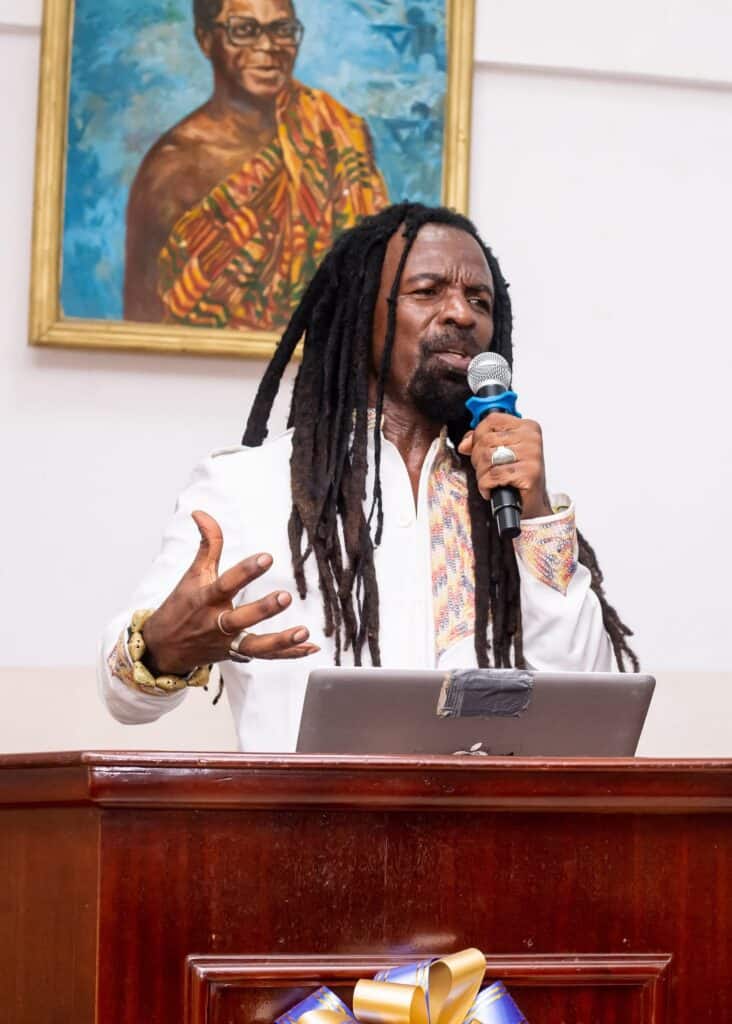
“The African Union has Agenda 2063, which is about the Africa We Want. I will modify it and say we must be pushing for The Africa We NEED”, Rocky declared.
“And the Africa we need right now is a UNITED AFRICA”, he added to thunderous applause.
He could tell he was having an effect on the young minds gathered. So he doubled down on the message, emphasizing that a united Africa was what would protect our lands, environment and resources and protect us from continuous exploitation.
“When I cast my gaze, what I see is a new colonialism where the power of might oppresses the weak and the helpless”, he warned noting that division, restrictions, borders and visas weaken us as Africans.
This is the new tone to the African unity agenda. It carries urgency and demands action. It distributes responsibility. The man who would normally come with a guitar today has only a mic, but he passes his message with the same clarity of thought and force of passion. Like Nkrumah and Nketia, he is doing his best to contribute to the long struggle for African liberation and unity. Hopefully his audience grasps the urgency of the task and takes it to the finish line, in their own interest. For only a united Africa can guarantee them the prosperous, peaceful future they deserve.