
Could the Nepal Disaster Mark a Climate Justice Turning Point?

On Wednesday, 26 August 2026, a section of a high-altitude glacier on the border of Nepal and Tibet gave way, resulting in flash floods across Nepal’s Rasuwa, Nuwakot, Dhading, Gorkha, and Tanahun districts, sweeping away homes, roads, and bridges, and cutting off entire communities. At least 65,000 people, including 22,100 children, have been affected. Hundreds of people, including children, have reportedly died, and thousands more are still missing; this number is likely to rise.
This disaster has garnered global coverage, but curiously, very little of that coverage has focused on climate justice. Nepal, one of the poorest countries on earth, contributes a vanishingly small share of global greenhouse gas emissions, and yet it is absorbing warming at roughly twice the global average, with catastrophic consequences for the millions of people who live in the shadow of its glaciers. Nepal did not create the crisis that is unmaking its mountains, but it is the one paying for it in lives.
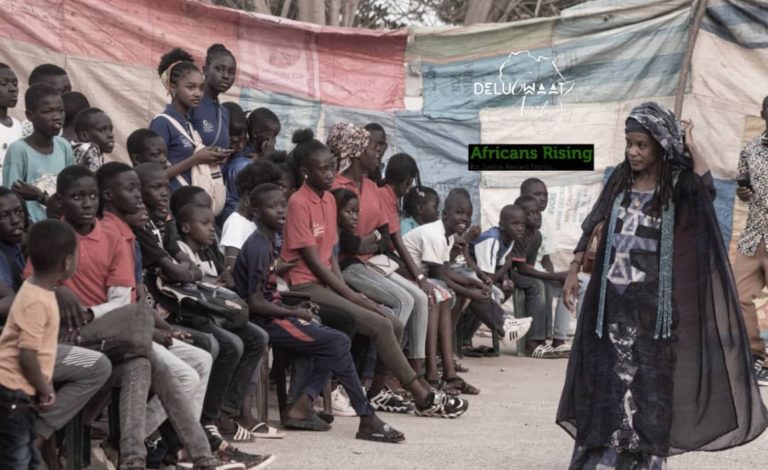
This is the exact injustice that Africans Rising has organised around for years. As the movement has put it, climate justice is fundamentally about African solidarity: the understanding that those who contributed least to the climate crisis should not be made to carry its heaviest burden. Africa, like Nepal, is responsible for only a small fraction of historical global emissions, yet the continent is already living through droughts, floods, and wildfires that are reshaping entire economies and displacing communities. The Himalayan glaciers and the Sahel’s shrinking rains are, in this sense, two faces of the same story: those with the least power to change the global energy system are the first and hardest hit by its failures.
Experts have explained that even with better monitoring, an event moving at nearly 200 kilometres an hour through a narrow valley leaves almost no time to warn, let alone evacuate, downstream communities. Better science can reduce risk, but it cannot substitute for the deeper structural work of building resilient infrastructure, safer settlement planning, and well-resourced disaster management institutions work that requires sustained financing, not just goodwill.
The Africans Rising argument, based on the Kilimanjaro Declaration, calls for reparative climate financing and genuine reform of institutions like the World Bank and IMF. Early warning systems, resilient housing, and community-level disaster preparedness across Africa cannot be built on emergency aid appeals issued after each flood or cyclone. They require predictable, adequate climate financing that treats resilience-building as a right rather than as charity dispensed by the same wealthy, high-emitting economies whose historical growth degraded the climate in the first place. The Kilimanjaro Declaration’s call for reparative justice is not an abstract demand; it is the difference between a community that can act on a warning and one left, like the villages along Nepal’s Bhote Koshi river, with only minutes to run.
A recurring point worth noting is that climate impacts are never distributed evenly, even within the same country. Wealthier communities can insulate themselves with air conditioning, insurance, sturdier housing, and faster evacuation options, while poorer communities absorb the worst of a flood, a heatwave, or a landslide with the fewest resources to recover.
This is the lived reality of Africa’s most marginalised communities, and it is why Africans Rising insists that any climate justice agenda must centre women, youth, people with disabilities, and other groups who face the sharpest edge of environmental degradation. A drought in West Africa or flooding in Southern Africa does not affect a rural smallholder farmer the way it affects an urban elite; a just response has to be built with the most vulnerable at the centre of the planning table, not as an afterthought once resources have already been allocated elsewhere.
For Africans Rising, the crux of the demand is historical redress: the recognition that decades of warnings were ignored by the economies most responsible for emissions, while the costs of inaction are now being paid, disproportionately, by the countries and communities least responsible for causing the crisis. Financial compensation and climate financing are not favours to be negotiated generously by wealthy nations; they are a debt accumulated over a century of extraction, and every new disaster, be it in the Himalayas or Mozambique, is another instalment coming due.
Sadly, Nepal’s disaster will fade from international headlines within weeks, just as this year’s European heatwaves and Mozambique’s floods have. But the pattern they reveal will not fade: a climate system destabilised by the emissions of a few, with consequences absorbed by the many who did the least to cause them.
For Africans Rising and the broader Pan-African climate justice movement, the response to that pattern is not despair but organised demand for reparations, for economic justice, for ethical governance of the resources meant to build resilience, and for a borderless, united Africa capable of facing a shared crisis with a shared voice. The mountains of Nepal and the plains of Africa are, in the end, part of the same argument: those least responsible for breaking the climate should never be left alone to bear the cost of repairing it.