
By Hardi Yakubu, Movement Coordinator, Africans Rising
What is Borderless Africa? Learn how free movement, visa-free travel, the African passport and AfCFTA could transform trade, jobs and African unity.
1. What is Borderless Africa?
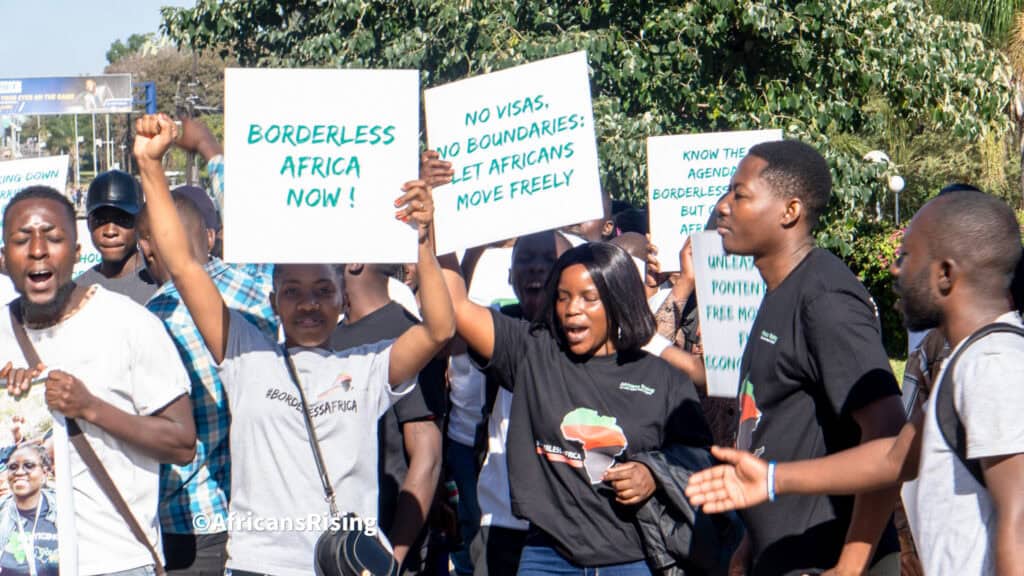
Borderless Africa is a people-powered continental campaign led by Africans Rising that advocates for
- the free movement of Africans across Africa,
- one African passport and
- a single currency.
Essentially, an Africa where colonial borders no longer prevent Africans from moving, living, working, trading, and building relationships freely across the continent.
2. Would visas disappear?
Yes. Visa restrictions to intra-African travel have negative cultural, political and economic consequences. According to the African Development Bank, the tourism potential of Africa is hindered by visas, which restrict movement, trade and labour mobility across the continent. We want an Africa where someone from Senegal does not need a visa to travel to Tanzania or vice versa. Visas were introduced in Africa by colonial forces to restrict the movement of Africans across colonial territories for fear that they would collaborate and fight together against the colonial systems.
3. How would free movement work?
By removing visas and other restrictions to intra-African travel. This means an African from Senegal should be able to travel to Tanzania without having to apply for a visa. It does not mean the absence of laws or security controls. Countries would still collect information about entry and exit, protect public safety, and enforce their laws, but African citizens would enjoy greater freedom to move within Africa.
4. Would free movement make Africa less secure?
No. It would rather increase collaboration and make cross-border crime easier to fight. Some people think free movement will bring insecurity. Quite the contrary. Trans-national crime has already showed that the existence of the borders and visa restrictions doesn’t deter the movement of criminals. Crime is already borderless, so to speak. It is the law-abiding traders, businesspeople and workers who are being harassed and restricted. In a Borderless Africa, African countries will integrate their information gathering and sharing systems such that moving from one place to another doesn’t shield a criminal from accountability. Insecurity worsens when countries act in isolation. The African Union has recognized this and has concluded a security assessment noting that the benefits that will accrue from free movement far outweigh the perceived security threats.
5. How would traders benefit from Borderless Africa?
Small-scale and cross-border traders would face fewer visa, immigration, customs and bureaucratic barriers. Moving goods across borders would become faster and cheaper, while access to larger markets would create more opportunities for small businesses. For millions of African traders, especially women who dominate much of informal cross-border trade, freer movement could have a direct impact on livelihoods.
6. How is Borderless Africa different from AfCFTA?
Both focus on free movement. But while the African Continental Free Trade Area (AfCFTA) focuses on ensuring the free movement of goods and services and increasing intra-African trade, Borderless Africa complements this by putting the free movement of persons at the centre of the agenda. Because goods do not move themselves. People move goods. People offer services. This is why the AfCFTA protocol was adopted by African leaders at the same time in 2018 with the Protocol on Free Movement
7. What is the AU Free Movement Protocol?
The Protocol to the Treaty Establishing the African Economic Community Relating to Free Movement of Persons, Right of Residence and Right of Establishment is an African Union framework designed to progressively facilitate the movement and rights of Africans across the continent. It seeks to establish rights relating to entry, residence, and establishment as part of the Agenda 2063. Its implementation depends on ratification and action by African states. However, only 4 countries have ratified it so far, while it requires 15 to come into force.
8. Won’t everyone move to Africa’s relatively richer countries?
No. There is a myth that if there is free movement of persons in Africa, everybody will migrate to more developed countries. This is not true. How do we know? There are countries that have already removed visas for African citizens traveling to those countries. While this has increased the number of people traveling there for tourism and business, there is no evidence that there is an exodus from other countries to the visa-free countries.
9. Which countries already allow visa-free entry for Africans?
The following African countries already allow citizens of other African countries to enter without obtaining a visa in advance.
- Kenya
- Rwanda
- Seychelles
- Benin
- The Gambia
Togo announced earlier this year its version of visa-free entry; however, it is not full visa free as travellers still have to fill out travel documentation at least 24 hours before travel, as reported by the Business Insider Africa. The Republic of Congo has also announced its visa-free policy to take effect from January 2027 (See this report by AllAfrica). Ghana and Burkina Faso have removed visa fees for Africans while still requiring prior approvals for some categories of African travellers.
Other countries offer varying degrees of visa openness, and you may refer to the Visa Openness Index published by the AfDB.
10. What about jobs?
Job creation will be significantly boosted by free Movement of persons, goods and services. Studies by the African Union, the UNCTAD have found that increased intra-African trade as a result of free movement will have a positive effect on job creation. Due to restrictions and outward orientation of trade, we Africans do not trade among ourselves. Intra-African trade still hovers around 16% according to the UNCTAD’s 2024 Report. As we buy goods from outside the continent, we create jobs for other countries while unemployment, especially among the youth, keeps rising.
Some have asked whether persons moving from one place to another would not take the jobs belonging to locals. This will only be the case if planning is left to chance. African workers moving from one place to another create significant value in the destination country as noted by the African Center for Economic Transformation. In some cases (for example, South Africa), there is evidence that the presence of migrant workers actually creates jobs for locals, according to a study by the World Bank (https://unctad.org/system/files/official-document/aldcafrica2024_en.pdf )
11. What evidence shows that free movement can work?
Africa already has examples of relatively open movement through regional integration arrangements such as ECOWAS and the East African Community. There are significant challenges in these arrangements, but they demonstrate that countries can cooperate to facilitate the movement of people while maintaining laws and security systems. The evidence also shows that free movement works best when supported by effective institutions, infrastructure, identification systems and cooperation between states.
12. If Free Movement is so good, why hasn't it been implemented yet?
African leaders already agreed in principle back in 2018 to adopt the Protocol on Free Movement of Persons. However, the political will to move forward with ratification and domestication has been lacking. This is why people-led campaigns like the Borderless Africa campaign and other campaigns are important to build momentum and push political leaders to act.
13. How can I join the campaign?
Follow and share updates about the campaign on social media
Borderless Africa is ultimately a people’s project: an Africa that belongs to Africans and in which Africans are free to move, connect and build together.
Sources and further reading
Borderless Africa Explained: why free movement is the key to Africa’s future
Study on the Benefits and Challenges of Free Movement of Persons in Africa
Africans Rising Borderless Africa Campaign
Economic Development in Africa Report 2024
Mixed Migration, Forced Displacement and Job Outcomes in South Africa
About the author
This piece is written by Hardi Yakubu, Movement Coordinator of Africans Rising. His work focuses on Pan-African movement building, African unity, free movement, and grassroots mobilisation for justice and continental integration.