
Notes on Feminism from Dakar
There is something funny about being a feminist in a room full of women who are doing feminist things while insisting they are not feminists.
You hear it all the time.
“I’m not a feminist.”
Then she tells you she wants to earn her own money, choose when she gets married, travel alone, take herself to the doctor, decide whether she wants children, say no without explaining herself, and raise her daughter to know she can become anything she wants.
I have started thinking that perhaps we have a naming problem.
We’re doing the verb. We just don’t want the noun.
And honestly? I understand why.
The word feminist has been handed to many women as a caricature: angry, bitter, man-hating, aggressive, difficult. Somewhere along the way, feminism became something women were expected to either defend or apologise for.
But what if feminism is much quieter than that?
What if it is simply the freedom to exist as a complete person?
Not just during the big fights. In the little ones.
The little ones matter.
Being able to drive.
Going to the doctor by yourself and being able to explain what is happening in your own body.
Going to school.
Creating your own work.
Choosing what you wear.
Choosing whether you want children.
Saying yes.
Saying no.
And then, perhaps most importantly, being allowed to stand by either answer.
That is feminism to me.
And increasingly, I think feminism has to include something we don’t talk about enough:
Rest.
My feminism looks like happy, relaxed, well-rested women.
Because rest is not laziness. Rest gives the heart, soul, mind and body room to heal. It gives you enough space to learn yourself, to think critically, to express yourself completely—and, most importantly, to look good while doing it.
An exhausted person has very little room for choice. She just wants to get through the day. She wants to “get over it.” She is stuck in a loop.
Always surviving.
Always in dis-ease.
I don’t want liberation as an abstraction.
I want it on a Tuesday.
I want women to have enough time and safety to enjoy their lives.
I want us to be sexually satisfied. Well educated. Beautiful if we want to be. Ridiculous if we want to be. To love flowers and the ocean and jazz playing while we cook. To drink red wine. To eat Benachin. To walk along the beach. To take naps. To buy pretty things.
And yes, I love men.
I really do.
I love their presence. I love taking care of them. I love being taken care of. Men are beautiful. They’re buff. Muscles are sexy. A deep voice can be both calming and extremely exciting.
I love how we can playfully command each other. How they can worship the ground we walk on. How they kiss us, hold us, protect us, make us laugh.
None of this makes me less of a feminist.
Because loving men is not the same thing as centring men.
I can love a man deeply without making his approval the organising principle of my existence.
And perhaps this is where feminism becomes most interesting to me: choice.
I want the freedom to build a career and still decide that I want to be a stay-at-home wife.
I want to teach in the morning, come home to a beautiful garden, have someone help run the house, travel, wear heels, put on makeup, receive an allowance, raise children, and have a husband who absolutely adores me.
I want to work and I want to rest.
I want intellectual life and domestic life.
I want ambition and softness.
I want marriage and autonomy.
I want children and an identity outside motherhood.
I want all of it.
My feminism does not require me to choose the version of womanhood that looks most impressive from the outside. It requires that the choice be mine.
Maybe that is why I think about Mama Gee so much.
I grew up watching Nollywood, where Patience Ozokwor was so often the angry woman, the wicked woman, the woman causing trouble. As a child, I saw her as someone who loved fighting, talking too much and generally disturbing everybody.
Then I grew up and watched her again.
And thought:
Oh.
That is me.
Not the wickedness, please.
But the audacity.
Mama Gee loved money. She wanted a soft life. She did not seem particularly interested in apologising for wanting either. In some films, she would practically tell women to choose themselves—to refuse a life of struggle when they could have something better.
As a child, I thought the lesson was: don’t become this woman.
As an adult, I started wondering whether that was sometimes the point.
How often does popular culture teach women about themselves by making powerful women into villains?
The loud woman becomes “too much.”
The ambitious woman becomes selfish.
The woman who wants money becomes greedy.
The woman who says no becomes difficult.
The woman who knows what she wants becomes dangerous.
And eventually, women learn to police one another.
This is especially interesting when I think about African women’s history.
I am uncomfortable with the idea that women’s liberation is something Africa simply imported.
African societies were—and remain—far too diverse for us to make sweeping claims about a single African gender system. But across many societies, women had longstanding forms of political, economic, social and cultural authority. Women organised, owned and controlled resources, resisted rulers, built communities, produced knowledge and challenged colonial power.
And then colonialism did something profound to the social fabric.
For me, the word I keep returning to is expression.
We cannot carry pride in coloniality while pretending it left everything intact.
Women resisted.
The Kom women rebelled against colonial interference in Cameroon. Aline Sitoé Diatta became a powerful symbol of resistance in Senegal. Taytu Betul was a political force in Ethiopia. Rose Chibambo fought in Malawi. Mariama Bâ later gave us language for women’s interior lives, choices and contradictions.
And then there was the Pan-African Women’s Organization.
Women from across the continent organised politically before the OAU even existed in its later form.
When I learned this, I genuinely thought:
Women really are the shit.
And then I wondered:
Why didn’t I know this?
Perhaps that is part of what colonialism leaves behind—not simply the loss of land or political power, but the disruption of memory.
We forget what women have always been capable of.
Then we look at women today and call their agency foreign.
I think this is also why I struggle with the idea of the “male-centred woman.”
Not because I think women who love men are foolish.
Quite the opposite.
Sometimes women become deeply invested in male approval because the system has taught them that approval is survival. They learn to protect the very structure that hurts them because they have learned how to survive inside it.
And so a woman may defend a man’s entitlement while attacking another woman for having boundaries.
A woman refuses to let a man move into her home without being on the lease, and suddenly she is a “man-hater.”
A woman says, No, you cannot do that in my house, and feminism gets blamed.
Meanwhile, somehow, the boundary is considered more offensive than the entitlement that made it necessary.
This is why I don’t think feminism is about hating men.
Don’t allow men who hate women to classify feminism as women who hate men.
Feminism is about women being allowed to belong to themselves.
And that brings me back to Dakar.
Dakar does not feel like some feminist utopia to me. I don’t think that is the point.
It simply made me notice women.
Women being artistic.
Expressive.
Beautiful.
Loud.
Soft.
Traditional.
Modern.
Religious.
Sexy.
Domestic.
Ambitious.
Contradictory.
Just being themselves.
And perhaps that is what I needed to see.
That feminism does not have to produce one particular kind of woman.
She can be the woman who leads a revolution.
She can be the woman making shea butter by hand.
She can be the professor.
She can be the woman buying fabric for her clothing line.
She can be the mother picking her children up from school.
She can be the woman walking alone along the beach.
She can be the woman deeply in love with her husband.
She can be all of these women.
Sometimes even in the same body.
My feminism is happy.
Peaceful.
Strict.
Open.
Intellectual.
Comprehensive.
And deeply, unapologetically alive.
I think about the woman I was before I had all these words.
The girl who knew what she wanted but sometimes worried about whether she was allowed to want it.
The girl who wondered whether she could be successful and soft. Ambitious and domestic. Intellectual and feminine. Independent and deeply loved.
I think I know what I would tell her now.
Don’t worry about the noun.
Keep doing what you’re doing.
Keep choosing.
Keep saying yes when you mean yes.
Keep saying no when you mean no.
Keep loving men without disappearing into them.
Keep wanting beautiful things.
Keep resting.
Keep learning.
Keep becoming.
You’re damn good at it.
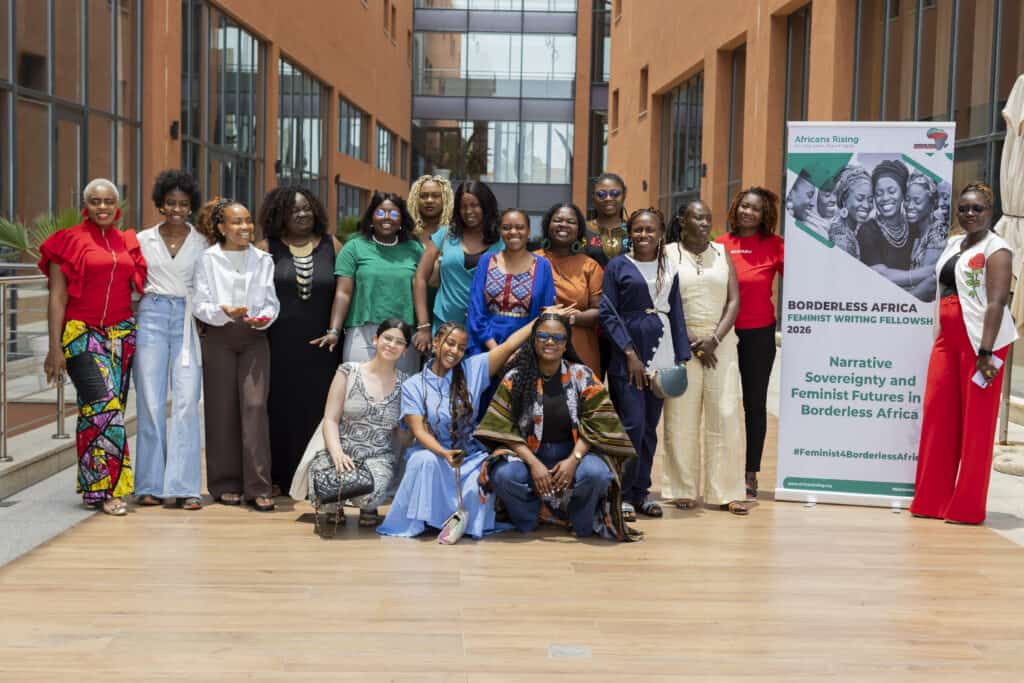
Brenda wanjiru is a borderless africa feminist fellow and Lawyer you can reach her on
dumebioloo@gmail.com